
Median branch isolation from first hostile signature to dead-route allocation.
 荒坂株式会社
Return to technology library
TECH-ICE-77 / COUNTERINTRUSION RUNTIME
BLACK ICE RUNTIME
Hostile-route computation for sovereign networks.
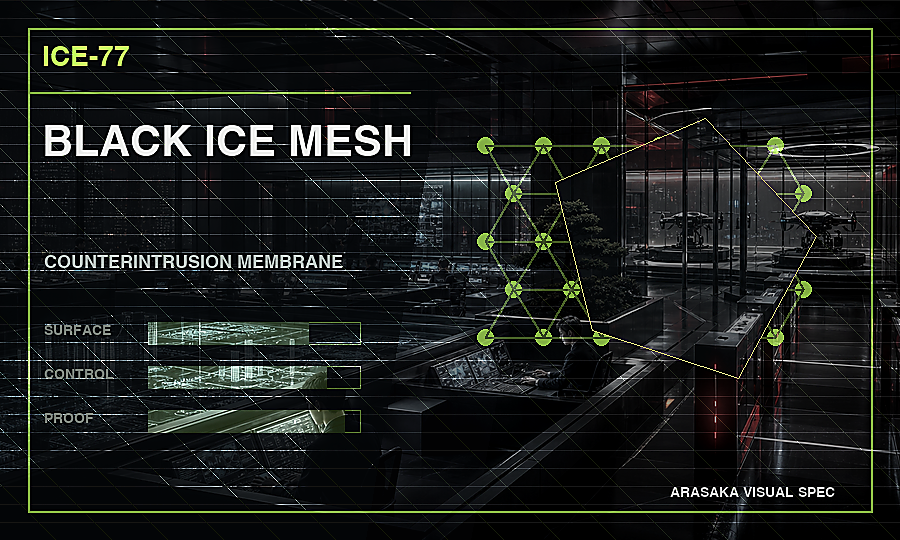
A compartmentalized counterintrusion runtime that turns every unauthorized netpath into a witnessed, disposable, and legally attributable quarantine event.
Minimum independent custody nodes required before a quarantine receipt is signed.
Default retention for hostile path fragments before statutory vaulting rules apply.
Runtime Stack
Four containment layers, one accountable receipt.
The runtime treats an intrusion as both a systems event and a governance event. Every computation is designed to preserve tactical advantage without leaving the client unable to prove what happened.
Sentry membrane
Passive signature drift, impossible credential geometry, and deep packet cadence are scored before the intruder reaches a valuable surface.
Trap partition
Suspect paths are mirrored into disposable compute where decoy assets measure intent, toolchain, and escalation appetite.
Route burn
Confirmed hostile paths are severed, memory-capped, and mapped to an evidence object before the attacker can pivot.
Quarantine receipt
A board-readable receipt binds time, path, signature, and proportional response into a sovereign custody ledger.
Signal Path
Intrusion becomes evidence before it becomes damage.
Engineering Envelope
Deployable constraints.
Ephemeral execution pools with one-way forensic export and no persistent hostile-write surface.
Rulesets are compiled from approved escalation policies, export controls, and client-specific proportionality limits.
An observer process scores anomalous machine intent without granting the client network a direct Blackwall dependency.
If witness quorum fails, authority collapses to named human operators and records the reason for board review.
Connected Records