
Median time from sensor consensus to permitted formation adjustment.
 荒坂株式会社
Return to technology library
TECH-SW-12 / AUTONOMOUS PROTECTION GOVERNANCE
AUTONOMOUS FORCE
Machine speed held inside human authority.
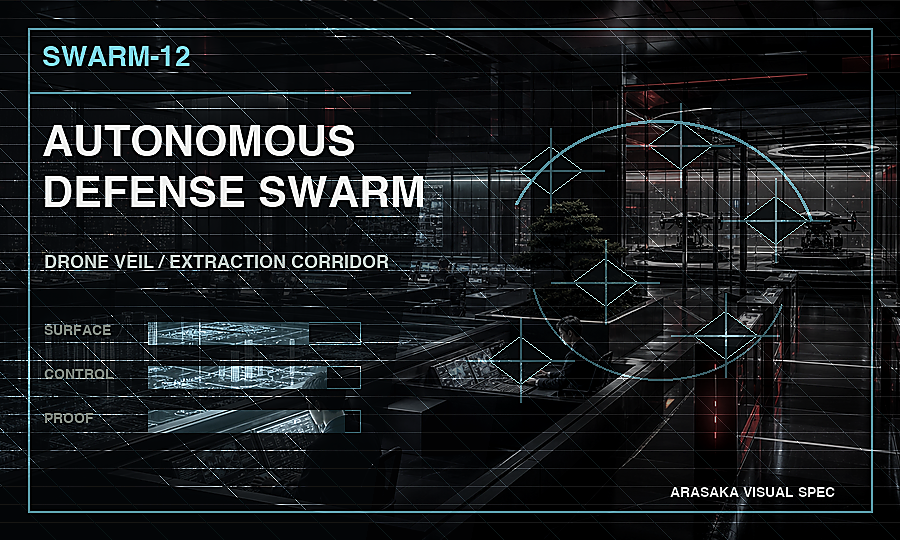
A command framework for drone swarms, perimeter veils, convoy corridors, and private-city defense where every autonomous decision remains bounded by exclusion maps and named escalation officers.
Civilian uncertainty coverage required before autonomous force may narrow a corridor.
Maximum authority handoff window before the system freezes into deterrence posture.
Governance Stack
Autonomy is useful only when command can audit it.
The governance stack separates sensing, formation selection, exclusion enforcement, and human escalation so a fast machine response never becomes an unowned act of force.
Sensor fusion veil
Drone, street, biometric, and convoy telemetry are merged into a single threat field before any unit changes posture.
Civilian exclusion map
The swarm must prove where not to act before it can prove where force is permitted.
Formation governor
Veil, overwatch, denial, and extraction formations are selected against mandate limits and local rules of engagement.
Escalation officer
Every force-bearing state binds to a named human officer, timestamp, and audit receipt before persistence.
Command Path
Protection corridors are computed as governance objects.
Engineering Envelope
Force constraints.
Formation instructions are accepted only after signed agreement across vehicle, street, and command nodes.
Corridors are compiled from private property boundaries, treaty zones, civil routes, and live civilian uncertainty.
The default action set prioritizes veil, obstruction, extraction, and sensory denial before escalation.
Every autonomous posture change writes a board-readable receipt with operator, location, confidence, and rule basis.
Connected Records